The Goddess of the Ancient World
by Jean Lestrale
There was a time, long before the advent of organized religions,
when nearly all of mankind instinctively perceived deity as a
loving and benevolent Mother Goddess, closely linked with the
Earth and their natural lifestyles. An overwhelming amount of
archeological evidence has been found to support this, throughout
the Middle East, Europe and Asia. How then did spirituality evolve
from that simple and peaceful concept, into the rigid formalized
religions that we see around us in the modern world today ?
The transformation began when barbarian warlords from the area of southern Russia and the Ukraine invaded the ancient world. We refer to them as Proto-Indo-Europeans (or "Kurgans"). They brought with them a blatantly self-serving religion, based on the glorification of a violent male war-god, which they used to justify their acts of conquest and domination.
As polytheism became the norm, many new pantheons of deities evolved. They were invariably lead by a war-god archetype, but usually also included a Mother Goddess figure in some lesser role. This practice continued until the collapse of the Western Roman Empire, when followers of an agressive and intolerant Hebrew war-god (i.e. the Christians) came to power. They violently attacked the other religions, looted their temples, murdered their priests and priestesses, and instituted the death penalty for anyone caught practicing any other religion. Thus the last remnants of peaceful goddess cultures disappeared from western consciousness, and the path that humanity was destined to follow would be one of strict religious control and exploitation.
Recently however, an ever-increasing body of historical and archeological evidence has begun to surface, which reveals a totally different account of human spirituality than the self-serving lies that have been foisted upon us for so many centuries. My intention is to provide an accurate account of the evolution of spirituality in the Western world, without the sort of apologetics and deliberate distortions so often found elsewhere.
I invite you to take an intellectual journey with me, into the ancient world of our ancestors, as we explore the true nature of our civilization and our spiritual heritage.
Paleolithic Artifacts
As we know, modern man (i.e.
Homo sapiens)
originated in Africa about 200,000 years ago. From there, they
spread into Europe and Asia, living by hunting and gathering,
in much the same way as various earlier species of hominids.
However, sometime around 50,000 BCE they began to fabricate
implements of a clearly more sophisticated nature, such as
tools for drilling and cutting, spear points, etc. This marks
the beginning of the
Upper Paleolithic era.
Archeologists believe that these advancements were made possible by the development of a spoken language, which enabled Homo sapiens to exchange ideas and pass on acquired knowledge. In addition to the practical tools which they made, they also left behind some amazing works of art, in the form of cave paintings and the so-called Venus figurines.
The first Venus figurine was discovered in southern France in 1864, by the Marquis de Vibraye. At that time archeology wasn't a true science... it was simply an amusement for wealthy men, akin to treasure hunting. As might be expected, the meaning of the figurine and it's age were a complete mystery to the Marquis... he did however coin the term "Venus figurine" to refer to it.
The next discovery was made in 1892 by Edouard Piette. In a cave in southern France he found a number of female figurine fragments, carved from mammoth ivory. One of these fragments was a very detailed head which has been named the Venus of Brassempouy, after a nearby local village. That carving has been dated to 23,000 BCE.
About the same time as the Venus of Brassempouy was discovered, another excavation was under way at Balzi Rossi in northern Italy, near the French border. The area has a large number of natural caves, and while exploring them Louis Jullien discovered a total of 15 female figurines. Of special interest were the materials used for the figurines, which consisted of green steatite (soapstone) and mammoth ivory.
There were no mammoths in that area, and green steatite is very rare... indicating that the materials must have been relatively valuable, and that the local people must have traveled or traded to obtain them. In addition, many of the figurines were small and had holes cut in the top of them, indicating that they had been worn as pendants. They have been dated to between 20-25,000 BCE.
The next figurine, known as the Venus of Willendorf, was found in Austria in 1908. It had been carved from limestone and decorated with a natural red ochre paint. Interestingly, the limestone used for it does not occur naturally in that area. It has been dated to about 23,000 BCE.
Another discovery occurred in 1925, when the Venus of Dolni Vestonice was found in the Czech republic. This figurine is the oldest known ceramic object in the world, being composed of a fired clay material, and dating to around 27,000 BCE.
Soon archeology began to capture the public imagination and receive much greater funding and support. This resulted in a veritable explosion in the number of Venus figurines being discovered. Between 1925 and the present over 100 more were found. As the excavations became more thorough, digging deeper and more carefully, even older figurines began to turn up.
Perhaps the most interesting figurine discovered so far comes from the Hohle Fels cave, which is located in southern Germany. There, in 2008, a female figurine known as the Venus of Hohle Fels was found. Carved from mammoth ivory, it dates to an amazing 35,000 BCE. In addition, just two feet from the figurine, a flute carved from vulture bone was found, which also dated to the same period.
Archeologists have debated the significance of the Venus figurines for decades. In general they usually discuss only one particular example at a time, and concentrate on an analysis of the site at which it was found, searching for some furthur evidence which may shed light on it's meaning. Unfortunately most Paleolithic objects were bio-degradable, and have not survived.
In the absence of any conclusive evidence some rather amusing theories have been put forth. One idea is that the figurines may have been a primitive form of pornography. Another speculation is that they may have been toys for children. Yet another possibility is that they were some sort of fertility charm. Let's briefly consider those ideas.
In recent years archeologists have begun to suspect that most of the Venus figurines, as well as the cave paintings, may have been made by women. The size of hand-prints which often accompany cave paintings corresponds to female remains of the time period, found in the area. Moreover, the details of the clothing which some of the Venus figurines are wearing indicates that the person who did the carving was very familiar with female attire. Since the typical division of labor was that men hunted while women made clothing, it seems more likely that women would have had that particular knowledge... and if women did indeed carve most of the figurines, it seems unlikely that they were created as a form of pornography.
The theory that the figurines were created as toys for children is equally problematic. Some small animal figurines have been found, which may indeed have been children's toys... but the Venus figurines were often carved from solid rock, and would have been much too heavy to be suitable for use as toys. In addition, if they were toys, why were there no other kind of figurines of that general size and composition ? Are we to believe that nearly every child's toy in Europe for over 20,000 years was a female figurine ?
Speculation that the figurines may have been some sort of fertility charm is somewhat more believable, yet it still leaves us with some unanswered questions. Although some of the figurines are corpulent, with exaggerated hips and breasts, they do not appear to be pregnant... indeed, many are quite slender. And if the people who created the figurines believed in using charms to encourage pregnancy, why didn't they create any similar charms for other purposes ?
Although archeologists have been reluctant to compare artifacts from different cultures and time periods, we may now have a sufficient body of evidence to draw a few simple conclusions. The sheer quantity of the figurines implies that there must have been some basic universal purpose for them... and the effort it took to create them, as well as the rare materials frequently used, clearly indicates that they were of some special significance and value.
Although the meaning of this early evidence still remains uncertain, it does hint at the possibility of a religious belief involving a primordial goddess of some sort... especially when seen in the light of subsequent history.
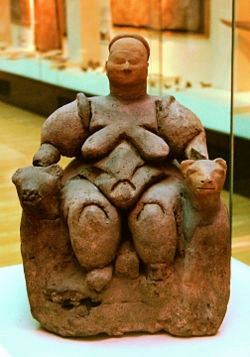
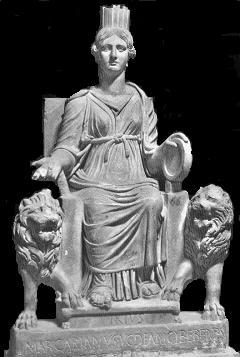
Mother Goddess statue from Catal Hoyuk (left), circa 6200 BCE.
Note the lions.
Roman statue of the Great Mother Goddess Cybele (right), made
over 6000 years later.
The Neolithic World
Around 20,000 BCE the Earth began to get dramatically
colder (see
last glacial period).
By 16,000 BCE Europe was almost completely covered with a
sheet of ice, which resulted in the extinction of all human
life on the continent. It would not be until about 10,000
BCE that climatic conditions would again allow humans, who
migrated from areas furthur to the south, to re-populate
Europe. This was the beginning of western civilization as
we now know it.
In order to gain an insight into the events of that distant time, which is so critical to our understanding of the modern world, we must rely entirely on archeology; the examination of whatever remaining artifacts we can find. These artifacts generally include the ruins of buildings, possesions such as pottery and tools, art objects, grave goods, and of course human and animal remains.
As a science, archeology is a relatively recent phenomena, having begun in earnest only a few centuries ago. Naturally, early attemps to recover ancient artifacts were clumsey at best. Precious objects were often destroyed by careless excavations, improper preservation, and looting. The total number of researchers involved in archeology was relatively low, and methods of recording and transfering data were tedious and unreliable.
Modern archeological techniques have greatly improved. There are far more people working in the field today, and the capability of computers to store and transfer data has made it possible for experts located virtually anywhere on Earth to collaborate. In addition, new technologies such as carbon dating, electron microscopes, ground-penetrating radar, and DNA analysis are providing us with a wealth of insights and discoveries.
One archeologist to whom we owe a great debt was Gordon Childe. Born in Australia in 1892, Childe attended Oxford and spent most of his life working in the UK. During the course of his career of roughly 30 years, he completely revolutionized our understanding of pre-history, and ultimately became the single most influential archeologist of the 20th century.
Unlike anyone before him, Childe presented an overview of human development, rather than merely a detailed description of some particular culture. Through a series of over 20 books, he established three key concepts which today form the basis for our understanding of the western Neolithic world.
First, Childe demonstrated that the origins of human civilization were in the Near East, and not the Middle East, as had been previously believed.
Second, Childe demonstrated that it had been people from the Near East who had introduced techniques of agriculture, the domestication of animals, and the production of woven fabrics into Europe. These advancements in human evolution are what characterize the so-called Neolithic Period.
Finally, Childe established that an invasion of Europe by people from the general area of the Ukraine occured between 4000-2000 BCE. He referred to these invaders as Proto-Indo-Europeans, and was able to determine that they were a patriarchal warrior society, who followed a violent male god, practiced human sacrifice, and believed in an after-life. They conducted elaborate burials in large mounds of earth called kurgans, from which their modern nickname is derived.
Childe's work was based entirely on the examination of artifacts and linguistic evidence. However, since that time a large number of new discoveries have been made which clearly confirm his findings. In addition to his brilliant technical work, he will also be remembered as a man who made archeology more accessable to ordinary people, with such wonderful books as "Man Makes Himself" (1936) and "What Happened in History" (1942).
Another well-known archeologist who played a major role in changing the world's views of pre-history was Jacquetta Hawkes. Born in the UK in 1910, she attended Newnham college in Cambridge. It was there that she met her first husband, Christopher Hawkes, a field archeologist. She started to join him on digs, and to uncover evidence of primordial goddess religion at various Neolithic sites.
Over time, she began to focus on the dramatic social and cultural changes which the invasion of the Proto-Indo-European peoples had brought about. Her insightful interpretation of evidence, and her eloquent style of writing attracted a great deal of attention... yet it was not until she began to explore the ruins of the Minoan civilization on Crete that her work would finally be taken seriously.
There, on that remote Aegean island, which had remained virtually untouched by the Kurgan invasion, she found overwhelming evidence of a society which had preserved a Neolithic goddess tradition well into the Bronze Age... and indeed, a society that was incredibly peaceful, artistic and prosperous. Through a remarkable series of books, newspaper and magazine articles, lectures, and radio and TV interviews, Hawkes portrayed the existence of primordial goddess religion and gender-egalitarian cultures to the public in ways that simply could not be ignored.
Although her work was controversial at the time, Jacquetta Hawkes remained steadfast and outspoken. Eventually, new discoveries began to confirm her theories... and fortunately she lived long enough to receive some of the recognition and honors that she deserved.
Archeologists such as Gordon Childe and Jacquetta Hawkes had the intelligence and insight to see beyond the mistaken presumptions of their peers, at a time when the evidence available to them was quite limited. However, if the archeological community required indisputable proof, it was a gentleman by the name of James Mellaart who would supply it.
Born in London in 1925, Mellaart seemed to posses a natural instinct for finding hidden ancient sites. Early in his career he made several amazing discoveries, including a large cache of bronze-age artifacts on Cypress, and a fully intact tomb in Jericho. Later, while wandering through the Turkish back-country alone in 1956, he discovered the Neolithic site of Hacilar, which contained figurines suggestive of a Mother Goddess archetype.
Yet it was Mellaarts next discovery which would become the final catalyst for fundamental changes in the view of pre-history, throughout the entire archeological community. In 1961, James Mellaart began the excavation of Catal Hoyuk, a site which would eventually be recognized as the most well-preserved Neolithic city that has ever been found.
Here, buried beneath a wind-swept and lonely hill, lay the remains of a civilization 9000 years removed from our own. Agriculture, the domestication of animals, houses with built-in cooking ovens, pottery, woven fabrics, jewelry, mirrors made of polished black obsidian, stone knives and other tools... it was all there. And best of all, James Mellaart discovered clear evidence of the world's first formalized religion.
Work on the Catal Hoyuk site is still in progress, however of the 300 houses excavated so far, fully 88 have contained shrines dedicated to a Mother Goddess, and dozens of primitive carved figures and murals depicting the Goddess have been found. She was often represented seated on a throne, surrounded by a pair of lions... clearly the image that we have come to associate with the Mother Goddess Cybele.
Without a written language, we shall never know what the people of Catal Hoyuk called themselves, or what they called their goddess, but it is quite clear that they existed in southern Turkey, from as early as 7000 BCE.
As might be expected, a tremendous controversy over the interpretation of the evidence ensued. There were some who said that Catal Hoyuk was some sort of an anomaly, and not truly representative of life in the Neolithic period. However, since that time many other Neolithic sites have been discovered in the Near and Middle East, and most of them have contained similar artifacts.
Catal Hoyuk was not a mere anomaly... it was in fact typical of it's era. Better preserved than most, somewhat more affluent and larger, but in many ways an eminently presentable example of it's type. Clearly, James Mellaart's work dramatically altered our understanding of the origins of human spirituality... but it would be another archeologist, Marija Gimbutas, who would extend that understanding throughout all of pre-historic Europe.
Marija was born in Lithuania in 1921, and was already an acomplished archeologist when she arrived in the United States in 1949. During her career, she conducted numerous excavations of Neolithic sites and uncovered a large number of household and religious artifacts. She began to see a pattern in them, which eventually lead her to focus on the cultural and spiritual practices of the people involved.
Around 1960, she began to use the new process of carbon dating to determine the exact age of artifacts, and to develop a very accurate chronology of pre-historic events. This enabled her to significantly refine Gordon Childe's Proto-Indo-European concept, into what she called the Kurgan hypothesis. Later, after 1990, techniques of DNA analysis furthur confirmed the scenario, to the point where it is the prevailing view in the archeological community today.
The original population of Europe had indeed come from the Near East. They were the same peaceful, artistic people who had built such cities as Catal Hoyuk. They practiced agriculture, had an egalitarian society, and appear to have worshipped the same sort of primordial Mother Goddess as was found in so many other places throughout the Neolithic Near East.
The Kurgan invasion began around 4000 BCE. It came in several waves, reaching various areas over a span of about 2000 years. The Kurgans arrived on horseback, bearing battle-axes, which had been previously unknown in the area. From the number of bodies found, who had obviously been killed with these weapons, we can deduce that the Kurgan invasion was a violent military-style assault.
That the indigenous people had an agricultural society can be determined by their diet and the particular sort of tools that they possesed. That they were generally peaceful is readily apparent from the lack of human-caused violent deaths prior to the invasion, and the absence of weapons of war. Moreover, they were an artistic people, which we can quickly appreciate from the ornate and beautifully painted pottery and other works of art, that can now be dated to the pre-invasion period.
The claim that the indigenous people worshipped a Great Mother Goddess is well-supported by the abundance of goddess figurines that they made. Finally, the fact that women had been accorded an equal status with men is indicated by their similar burials, and the quantity of grave goods found with their remains.
As each successive area was subjugated by the Kurgans many things changed. They installed a barbaric warrior hierarchy, and imposed their language and religion on the conquered people, the nature of which may be inferred from a large number of crude figurines of a rather stern-looking male god, often bearing weapons.
Although there has been considerable controversy about the work of Marija Gimbutas, it is diminishing rapidly as a new generation of archeologists with more sophisticated viewpoints replaces the previous one. In addition, early doubts about the exact age of artifacts and the identities of human remains have been virtually eliminated, as a result of carbon dating and DNA analysis.
Today, a new understanding of human history and spirituality is emerging in the public consciousness. Through the work of archeologists like Gordon Childe, Jacquetta Hawkes, James Mellaart, and Marija Gimbutas, we have learned that peaceful egalitarian goddess-based societies existed for thousands of years... and that patriarchy, warfare, and domination are not an unavoidable natural phenomena which has ruled our world forever. What effect these insights will have is uncertain, but what is clear is that it was these four men and women who, more than any other, made them possible.
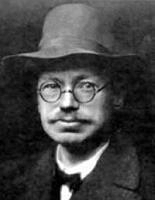



left to right: Gordon Childe, Jacquetta Hawkes, James Mellaart, and Marija Gimbutas
"Through an understanding of what the Goddess was, we can better
understand nature, and we can build our ideologies so that it
will be easier for us to live... We have to be grateful for what
we have, for all the beauty... and the Goddess is exactly that...
the Goddess is nature itself... and I think this should be
returned to humanity."
Marija Gimbutas, 1992
The First Great Nation
The
Sumerians
lived in what is now southern Iraq and Kuwait, surrounding the
extremely fertile delta between the Tigris and Euphrates
rivers... an ideal place for farming, where fresh water was
plentiful. They appear to have first arrived in the area around
5000 BCE.
The Sumerians were responsible for many significant advances, including the wheel, mathematics, codified laws, a money system, and most notably the earliest method of writing, known as cuneiform, around 3000 BCE. By that time, their civilization had developed into a true nation-state, with over a dozen cities and a total population of approximately 500,000. These cities were initially ruled by a priest-class, and later by a series of kings, allied with them.
Sumerian civilization came to an end around 2000 BCE, and their language was eventually lost to the world. Although archeologists had collected a large number of cuneiform clay tablets, it was not until the 1950's that the Sumerian language actually became intelligible to us. The largest repository of translated Sumerian cuneiform tablets can now be found in the University of Oxford's electronic text corpus.
One rather interesting aspect of the Sumerian language was the existence of two seperate dialects; Emegir, which was spoken by the majority of the people, and Emesal, which was used exclusively by wealthy and powerful women, priestesses, and by various goddesses when represented in mythological stories.
Prior to the Kurgan invasion, the primary deity of the Sumerians was the Mother Goddess Namma... however, with the arrival of the Kurgans, a frightening and destructive war-god known as Anu became dominant. After that, we see all the usual results of Kurganization... the creation of standing armies, the reduction in the status of women, and the conversion of religion from a spiritual activity into a mechanism of support for a violent and powerful ruling elite.
Namma was soon transformed into Ninhursag, the subservient spouse of Anu. We may consider the reduction in status of the original Mother Goddess, in becoming the spouse of a Kurgan male war-god, to be a form of compromise between the conquerors and the conquered people. However, once the concept of mutliple deities became accepted, people began to fabricate all sorts of "second generation" gods and goddesses, who would often posses much more violent and Kurgan-like qualities.
For example, from the union of the Sumerian god Anu and the Goddess Ninhursag came the grandchild Inanna, frequently classified as a goddess of love, sex and war. If we examine the poetry of the Sumerian high priestess Enheduanna (2285-2250 BCE) who wrote extensively about Inanna, we see her portrayed as a rather blood-thirsty and frightening entity, far removed from the benevolent Mother Goddess archetype. Other second generation goddesses, such as the Assyrian Ishtar and the Canaanite Astarte, also have similar disturbing qualities.
We know that around 5000 BCE the Sumerians came from somewhere to the north. In addition to their worship of a Mother Goddess, many other aspects of their culture bear a strong similarity to those of the Hattian people of Turkey. At sites such as Catal Hoyuk we have often found that the dead were buried below the floors of the houses, particularly in the shrine rooms. This custom is also found in Sumer, and was practiced without interruption until the end of their civilization around 2000 BCE.
Sumerians were known to make a distinctive hand-clasp when praying, which we see illustrated in many carvings and statues. Indeed, many of the dead were found buried with their hands clasped in that manner. This is exactly the same clasp that has been observed with followers of the Goddess in Turkey, and later with the Roman priestesses of Cybele.
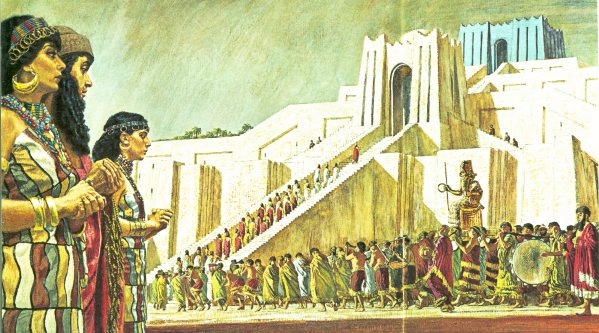
Artist's drawing of a ritual at the Great Ziggurat of Ur,
circa 2000 BCE
(note the clasp being made by the people on the left)
Yet another interesting similarity concerns the existence of
transgender
priestesses within the Sumerian clergy. We find
several types mentioned in very early primary sources. The Gala
priestesses apparently petitioned the gods through singing,
dancing, and various incantations. The Kurgarra and the Assinnu
priestesses were associated with the Goddess Inanna, although
their role is not completely clear.
Although born male, these types of priestesses lived as women, adopted female names, and spoke the sacred feminine dialect of Emesal. Their existence is traceable to pre-Kurgan times, circa 5000 BCE or earlier. While modern historians struggle to explain their significance, it seems clear that they could not have attained such a privileged and honored position without having some genuine positive qualities.
If we consider that the Sumerians were not Semitic, and are believed to have come originally from the north... as well as the many similarities between their culture and the Hattian culture of Turkey... we might speculate that they shared a common ancestory. Their civilization prospered due to the fertile lands which they inhabited, but around 2000 BCE the agricultural output of Sumerian farms began to decline substantially. Centuries of irrigation had gradually deposited enough dissolved salt into the soil to permanently destroy it's fertility. Then, an invasion by the Elamites from the east (modern-day Iran) made furthur habitation of the lower delta of the Tigris and Euphrates rivers impossible. As a result, between about 2000-1700 BCE the Sumerians migrated northwards, merging with the Akkadian peoples of central Iraq. There they would help to build another of the ancient world's great nations... the legendary city-state of Babylon.
Artists of the Aegean
The story of the
Minoan civilization
on Crete is of special significance because their island
location enabled them to avoid a direct invasion by the Kurgans.
Therefore their society in many ways demonstrates how peaceful
goddess cultures might have evolved, if allowed to follow a path
of their own choosing.
The first evidence of a large-scale continuous occupation of the island does not appear until about 6000 BCE, so obviously the population was not indigenous. The original colonists probably arrived on rafts... in which case, the prevailing currents in the Aegean Sea indicate a point of origin somewhere on the western coast of Turkey. The currents run at a speed of about 1 knot, and the distance is about 200 miles, so they might have made such a journey in as little as 8 days.
Beginning around 6000 BCE we find typical Neolithic settlements on Crete, which closely resemble those found in Turkey during the same time period (see Catal Hoyuk, etc). For example, agricultural crops such as wheat, barley and lentils are in evidence, as is the domestication of sheep, goats, pigs, and cattle.
From 6000 BCE until about 2800 BCE the people of Crete seem to have had no contact with the outside world, and remained at much the same level of development. However, around 2800 BCE, we begin to see evidence of trade with the Cycladic islands, western Turkey, and the Phoenicians of Lebanon, in the form of pottery and some copper objects.
By about 2600 BCE, techniques of weaving and of making bronze began to arrive on Crete... and with each passing century, contact with the more advanced societies in the region continued to benefit them. Yet it was not until about 2100 BCE that a major revolution of technology occured, which truly marks the birth of what we now call the Minoan civilization.
In order to properly understand this great technical revolution we must take a moment to consider the general situation in the Aegean at the time. The western states of Turkey and the Phoenicians were the predominant seafaring powers. The Phoenicians themselves had most probably migrated to Lebanon from Turkey, sometime around 4500 BCE. Indeed, although they were surrounded by the Canaanites on three sides, they always remained a distinctly seperate group, whose society bore many similarities to those of western Turkey, such as their advanced shipbuilding techniques, architecture, artistry, etc.
The people of the western states of Turkey, the Phoenicians, and the Minoans all shared a peaceful Goddess-based philosophy... and by 2100 BCE they were known to have close cultural ties and friendships. Around that time an invasion of Turkey by the Hittites began, as well as an invasion of Phoenicia by the Amorites. Archeological excavations reveal that habitation of Phoenicia virtually ceased at exactly that time... their great and thriving cities, such as Tyre, Sidon and Byblos were suddenly abandoned.
Meanwhile, at exactly at that time, great changes came to Crete. Large and beautiful palaces were built, such as the one at Knossos, which was discovered by Sir Arthur Evans in the early 20th century. The Minoan palaces strongly resemble those found in Phoenicia and western Turkey... they featured hot and cold running water, flush-toilets, ventilation and lighting shafts, etc. In addition, a network of paved roads interconnected the various areas of the island, while canals and pipelines transported water for such things as reservoirs and fountains. In addition, many types of specialty and craft shops existed, as well as apartments for the common people.
Furthurmore, two unique systems of writing also appeared at this time. One, known as Linear A, bears an amazing similarity to another script of that general time period, which was later discovered by Heinrich Schliemann in the ruins of Troy. The other writing system is known as Cretan hieroglyphs, and also appears to have originated in Turkey. Unfortunately, we have yet to decipher either of them.
Some additional clues can be found in the Minoan use of mountain-tops and caves for their religious rites, as well as their distinctly Near and Middle-Eastern burial customs... all of which first appear on Crete at this time. This evidence suggests that both the Turks and Phoenicians, fleeing from a military invasion, migrated to Crete around 2100 BCE... and they brought with them a highly advanced technology, which would become the basis for the golden age of the Minoan civilization.
Between 2100 BCE and 1500 BCE, the Minoans became the greatest seafaring nation in the eastern Mediterranean. Their many manufactured goods, especially pottery and bronze objects, were of the highest quality... and through trade, they accumulated vast fortunes. Moreover, during this entire 600 year period, there is no record of them ever having any involvement in a war.
The story of the Minoans came to an abrupt and tragic end around 1500 BCE, when a nearby volcanic island known as Thera exploded. The Thera eruption was one of the worst in recorded history. Thera was completely destroyed, and a massive tsunami struck the north coast of Crete, which would have destroyed any ships in port at the time. Volcanic ash then fell on Crete, causing the loss of most of their agricultural crops.
The eruption of Thera, in conjunction with several large earthquakes, severely damaged the Minoan civilization. In addition, the Mycenaean Greeks, attracted by the great wealth of the Minoans, took advantage of these natural disasters and launched a military invasion. Archeologists tell us that around that time the Minoans seem to have completely disappeared, leaving behind their beautiful palaces and once-thriving cities.
Meanwhile, at Tyre and Sidon in Phoenicia, excavations reveal that around 1450 BCE both cities became permanantly repopulated, and quickly grew into vibrant centers of trade. Yet another clue comes to us from their system of writing, known as the Phoenician abjad. As Sir Arthur Evans was quick to note, many of the symbols in the abjad are almost identical to those used in the Cretan hieroglyphs.
Could the Minoans, when faced with a volcanic eruption, earthquakes, and an attack by the Mycenaean Greeks, have made the decision to migrate... and might they have chosen to return to the very places with which their ancestors had close historic ties ? It seems probable that some of the Minoans relocated to the western states of Turkey, while others apparently returned to Phoenicia, which they quickly built into a world-class trading power.
If this theory is correct, it may very well explain why, during the Trojan war in 1200 BCE, when the western states of Turkey and their allies attacked every coastal city in the eastern Mediterranean, there was one significant exception... they never attacked Phoenicia, even though the Phoenician cities were quite wealthy, and lacked any heavy defenses.
Looking back on the Minoan golden age, we see a people whose prosperity was based not on conquest and pillage, but on manufacturing and trade... and who managed to avoid war almost entirely. Although their written records still remain undeciphered, the many beautiful frescoes in their palaces speak to us of a happy people, enjoying a good life. There is not one depiction of warfare, nor a harsh-looking monarch to be found. Indeed, their cities included few fortifications, and no significant cache of weapons or other military equipment has ever been found.
Without exception, the Minoan frescoes portray the beauty of the natural world. People and animals are shown in idyllic, pastoral settings. Bright cheerful colors predominate. There are not many depictions of deities, however a number of scenes do show women who appear to be priestesses... such as the "Ladies in Blue" frescoe, from the Palace of Knossos, circa 1600 BCE.
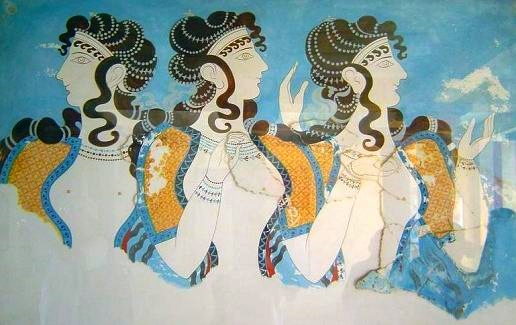
"Ladies in Blue"
Our knowledge of Minoan deities comes primarily from depictions
on cylinder seals, and figurines found near intact shrines. All
of the deities portrayed are female. Archeologists continue to
debate whether the various images are merely aspects of one Great
Goddess, or are in fact seperate deities. The images are usually
described as a fertility goddess, an Earth goddess, a Mother
Goddess, a mistress of the animals, a household goddess, etc.
One image which is especially interesting was found on a cylinder seal in the palace of Knossos. It depicts a woman standing on a mountain-top, flanked by two lions. Clearly, that is the image which we have come to associate with the Mother Goddess Cybele, as found in Turkey.
Another interesting symbolic object frequently found on Crete is the labrys, or double-edged ax. When depicted in murals these axes are always held by women, in what appears to be a ceremonial manner. They may have been a mark of royalty, or more likely had a religious significance... for example, as a representation of a priestess's authority to perform sacrifices, in order to provide food for the community. It may be noted that the double-edged ax was also used as a religious symbol in the Near East.
It's clear the Minoans possesed a peaceful society based on trade, with an advanced level of technology and art, and a religion involving female deities and clergy. Their civilization demonstrates that violence and patriarchy are not simply a natural result of population increases, or jealousy over material wealth... rather, they are linked to the fundamentally different sort of cultural values that arrived with the Kurgans.
Events in the East
At the same time as Proto-Indo-Europeans (i.e "Kurgans") from
the area of the Ukraine were invading the Middle East, and later
Europe, they were also launching attacks towards the east. These
attacks began about 2300 BCE, and would eventually reach as far
as the Indian subcontinent.
In the first wave, the Kurgans penetrated through central Asia and into modern-day Iran. Very little is known about the indigenous culture that previously existed there. Following the Kurgan conquest, between about 2300-1700 BCE, a new subculture became evident, known as the Proto-Indo-Iranians.
One distinguishing quality of this subculture was the language; it was a combination of Proto-Indo-European and that of the indigenous peoples. Beyond that, it was the same sort of barbaric, violent and patriarchal Kurgan society which we are now all too familiar with.
Around 1700 BCE, a second wave of expansion began... not from the Kurgan homeland itself, but from the conquered territory in Iran. It is sometimes referred to as the Indo-Aryan migration, "Aryan" being the name of the Proto-Indo-Iranian people in their own language. This second eastward wave of expansion entered India from the northwest, in the area of the Indus Valley, which is now part of modern-day Pakistan.
Settlements in the Indus Valley began as early as 7000 BCE, and were roughly equivalent to those found in the Neolithic Near East. By about 3300 BCE, numerous large cities with many advanced technical features existed, including water drainage and sewer systems, wells, grainaries, and ship building docks. There is no evidence of any social class or gender distinctions. All the homes were very similar, and the grave goods found with women were of equal value to those found with men. The personal effects of the population, such as pottery and jewelry, were very artistic and beautifully decorated... and from the large number of female figurines that have been found, archeologists believe that the people probably worshipped a Mother Goddess of some sort.
Their peaceful way of life, however, was about to come to a tragic end. Beginning around 1700 BCE, heavily armed Kurgan invaders on horseback and chariot entered the area. The large number of unburied corpses found at cities like Mohenjo-daro (literally, "mound of the dead") bear witness to a violent military-style assault. By 1500 BCE every city in the region had been abandoned. The population (or what was left of it) began a massive migration eastward. It would buy them a little time, but in the end the Kurgans would follow. Ultimately, as in Europe and the Middle East, India fell under Kurgan domination, and the old goddess cultures were forced to adopt a new social and religious order.
Just as they did in the western world, the Kurgans installed their war-god as the chief deity in the conquered lands. The earliest written records that we have from India are the Vedas. They are religious texts, dating to around 1500 BCE, and were originally written in Sanskrit, which is an Indo-Aryan language. They therefore provide us with an excellent window into religious beliefs immediately following the Kurgan invasion, from the point of view of the Kurgans themselves. As we might expect, the cheif deity is now Indra, a god of war. He is referred to in the Rigveda as the "mighty one", under whose control are all horses and chariots.
The Vedic period (approx. 1500-500 BCE) was characterized by the institutionalization of Indo-Aryan culture. During this time a system of classes was established, the remnants of which are still in existence today. This system was proclaimed in a religious text, written in Indo-Aryan Sanskrit, known as the Manusmriti. It was apparently intended to sanctify Kurgan domination, and maintain the purity of their blood lines as they governed a nation with such a large non-Aryan population. It should come as no suprise that even today members of India's upper classes have a much higher percentage of Kurgan haplogroup R1a DNA... for example, fully 72 percent of the Brahmins in Bengal posses this type of DNA.
The Vedic period is regarded as the time of origin of Hinduism, which in some sense is correct since traditional Hinduism was based on the early Sanskrit texts from that period... however, it should be noted that those texts are not natural products of India. Rather, they are representative of the Indo-Aryan (i.e. Kurgan) culture and belief system, which was imposed on the indigenous people.
As we can see, the Kurgan invasion initially had a similar effect on religion in India as it did in western areas. The simple universal role of the Mother Goddess archetype came to an end, and Kurgan war-gods were placed above her. As might be expected, during the confusion which followed, many new deities sprang up... most of which had various culturally-mixed qualities. This can still be seen in many sects of modern Hinduism.
The classic Vedic period lasted until about 500 BCE, when other schools of thought began to influence the Indian people. Buddhism was particularly significant... it rejected Vedic Brahmanism, with it's focus on attaining salvation after death, and replaced it with the concept of achieving liberation in this world, through increased self-awareness and an enlightened way of living. Buddhism was also especially critical of the Vedic practice of animal sacrifice.
Over the centuries, Vedic Brahmanism was forced to make major changes to it's doctrine and practices, and absorbed many of the new Buddhist concepts. This resulted in what we now call modern Hinduism. Fortunately, the religious landscape was such that although people still continued to regard themselves as Hindu, they were also willing to adopt new ideas and form new sects of the religion with unique practices and beliefs. This allowed religious diversity to develop in a peaceful way, and enabled the story of the Goddess in India to have a far different outcome than it did in the west.
In modern Hinduism, a sect has re-emerged which had been suppressed during the Vedic period. It is called Shaktism, which means "the doctrine of the Goddess". Shaktism has roots in the pre-Kurgan religion of the Indus Valley civilization, and focuses mainly upon a Mother Goddess similar to the one which seems to have been worshipped there.
One of the most important texts in Shaktism is the Devi Mahatmyam (literally, "Glory of the Goddess") written around 400 CE. The text proclaims the Goddess as the supreme power in the universe, and not merely the subservient spouse of some Kurgan war-god. This constitutes a very significant rejection of patriarchal Indo-Aryan dogma, and a clear revival of earlier beliefs.
In tantric versions of Shaktism, certain metaphysical dimensions of the universe are recognized... and there are also non-tantric versions, which are more focused on the philosophy of peace and cooperation that the Goddess inspires. Shakti worship is very diverse and vibrant, and can take many forms. While the Goddess is known by various names throughout India, they are all recognized as manifestations of the same entity... Adi Shakti, the primordial cosmic force of creation.
Clearly, in India, the Goddess has survived the Kurgan invasion. She is alive and well, in the hearts and minds of millions of Indian people... whose reputation for spiritual enlightenment, and a peaceful way of living, demonstrates the sort of positive values that I know we all share and appreciate.
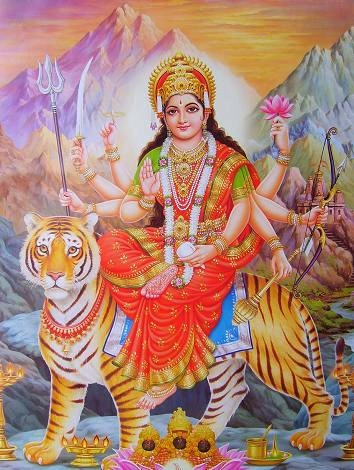
Adi Shakti (as Durga)
Fall of the Titans
The
Bronze Age
began in the Near East sometime around 3300 BCE, and although
the discovery of the bronze-making process was an important step
in human evolution, certain other events were of even greater
significance. The invention of systems of writing around 3000
BCE was a true milestone for western civilization, which would
make possible so much of the progress and technological
advancements to come, as well as providing us with many
valuable insights into our past.
Without doubt however, the event which had the most profound impact on the course of western civilization was the Kurgan invasion. It brought radical changes to every aspect of the life of the indigenous people. This included the establishment of violent and barbaric warrior kingdoms, whose prosperity was based upon the enslavement of innocent people, large-scale organized warfare, and the reduction in the status of women to mere property... supported by a religious belief-system in which violent male war-gods encouraged and sanctioned such behavior.
The term "Bronze Age" came into use before the facts about the Kurgan invasion were known. It was a convenient way to classify various archeological sites... but in light of our present understanding of the relative importance of events, terms like "pre-Kurgan" and "post-Kurgan" seem more appropriate, as we attempt to trace the development of our culture.
The Kurgan invasion began sometime around 4000 BCE. The earliest waves must have passed directly through the Near East, but appear to have continued onwards towards the large wealthy Sumerian cities farther to the south. Following the conquest of each particular area, life for the indigenous people was dramatically altered, as their long-established goddess cultures were forced to accept the new Kurgan war-god. This caused a great deal of spiritual confusion, which eventually resulted in various forms of polytheism.
In the Near East, records dating to about 2400 BCE tell us that the central and southern parts of Turkey were occupied by an artistic and peaceful group of people known as the Hattians. They were in fact the indigenous people... descendants of the Neolithic culture that had built such magnificent cities as Catal Hoyuk.
Around 2100 BCE, a tribe of Kurgans known as the Hittites entered Turkey from the general area of the Ukraine. Perhaps they knew that the cities furthur to the south were already heavily militarized and fortified... which meant that Turkey, although clearly not as wealthy, would be much easier to conquer. In any case, the Hittites decided to establish their kingdom in Turkey.
The Hattians recognized the military superiority of the Hittites, and wisely chose to yield control to them without resistance. As difficult as this may have been, it spared them from great loss of life... and in addition, it enabled them to better preserve their form of goddess religion for future generations.
The name of the original Hittite war-god is not known... in later accounts his name is given as Tarhunt, which is the Hittite translation of Teshub, an older war-god of their neighbors and allies, the Hurrians.
The Hurrians had invaded the Near East several centuries before the Hittites, and controlled the area immediately to the southeast of the Hittite kingdom, in what today would be northern Iraq. Apparently their war-god, and that of the Hittites, were regarded as more or less the same deity. He was frequently depicted riding in a chariot, carrying a mace or a battle-ax... just as did the Hurrians and the Hittites themselves.
Over time, the Hittites adopted some of the cultural and religious practices of the indigenous peoples, including belief in the Mother Goddess of the Hattians. The original name of the Goddess is unknown, however she seems to have evolved into Arinniti , the spouse of Tarhunt.
On the western coast of Turkey things followed a somewhat different path, as the indigenous people in that area had managed to remain relatively independent. They possesed considerable wealth, obtained through commerce and trade... and this enabled them to hire mercenaries and quickly mobilize large armies for self-defense, when necessary. Therefore, goddess religion retained more of it's original character in the western states, and their societies were typically more peaceful and prosperous.
As the second millennium unfolded, the major nations in the region grew more powerful, and bitter rivalries developed. The Greeks contended with the western states of Turkey for dominance in maritime trade. The Hittites fought the Egyptians for control of Canaan, while Babylon struggled to combat the growing power of Persia to the east. Although no one at the time realized it, the stage was set for a massive regional conflict that would bring down the great civilizations of the Bronze Age, destroy hundreds of cities and towns, and leave hundreds of thousands of people dead. It would be called the Trojan War.
The war takes its name from the fact that Troy was the capitol of the most powerful of the western Turkish states, known as Troad. The conflict began around 1250 BCE, when the Hittites seized the island of Cyprus for it's rich copper mines. Cyprus was allied with the western states of Turkey, who depended on it for their own supply of copper. They reacted by using their great wealth to hire mercenaries, and launched a massive attack on the Hittites, which completely destroyed their empire and left all of Turkey in Trojan hands.
Unfortunately, the end of the Hittite empire destabilized the entire region, and resulted in a series of battles between the Trojans and the kingdoms of Canaan and Egypt. Furthurmore, when the Greeks learned about these battles, they decided to take advantage of the fact that the western states of Turkey had been left relatively undefended, and to strike a blow at their maritime rivals. They therefore launched a suprise attack against the Trojan homeland, which caught the Trojans off-guard. The Trojans retaliated by using their formidable sea-power to attack and destroy nearly every coastal city in Greece. Eventually however, they became engaged on too many fronts, found themselves and their allies outnumbered, and were defeated.
In the end, the entire region was devastated. Both the Hittite and Trojan empires had been literally wiped off the face of the Earth. Canaan was reduced to a complete ruin. Egypt had been forever crippled as a world power... while Greece, although it had suffered severe damage, was the last man standing.
The Trojan War marks the end of the Bronze Age. Most of the great metalsmiths were dead, their foundries destroyed, and their secrets lost. The so-called Iron Age would now begin, with this crude and ugly metal taking the place of bronze. In addition, most of the literate people, the scribes, scholars, and teachers, had been killed... which is why so few records from this time can be found. Even Greece entered into a period of complete illiteracy, known as the Greek Dark Ages, which lasted nearly 400 years. Indeed, they would have to adopt an entirely new alphabet, in order to enable writing to begin again.
This tragic outcome was not simply the result of competition over scarce resources, or "too many people in too small of a space"... clearly, it was the consequence of a profoundly flawed philosophy and world view. In the beginning, attacking defenseless people in order to rob and enslave them was relatively easy... however, once the region became heavily militarized, furthur attempts to use violence to subjugate others only resulted in a series of pointless and costly wars. Apparently those in command failed to grasp the implications of this pattern. Therefore, as the various nations in the region became more powerful, and their armies grew in size, it was inevitable that a disastrous conflict would occur.
The philosophy of violent conquest and domination, firmly rooted in the worship of tyranical and vicious war-gods, had brought about an all too predictable tragedy. One can only wonder how much better off our world would be now, if such a vast amount of blood and treasure had not been wasted on such a foolish and destructive war.
Classical Antiquity
In the aftermath of the Trojan war, new nations would replace
their Bronze Age counterparts as dominant powers in the region.
The Greeks recovered from the conflict within a few centuries,
and were able to take control of the western states of Turkey,
while a powerful nation from the eastern Balkans, known as
Phrygia,
seized the territory of the former Hittite empire in the central
part of the country.
The Kurgan invasion was now fully completed, and all of Europe, the Near and Middle East, and Asia (as far east as India) was now either in Kurgan hands, or in the hands of indigenous people who had become fully Kurganized. Every nation now had a complex pantheon of deities, with a violent male war-god as their leader. The Goddess continued to occupy various secondary positions, often becoming the subservient spouse of the war-god.
Clearly, the first millennium BCE was a time of great innovation for Greek society. The destruction caused by the Trojan War necessitated a major reconstruction of many of their fundamental institutions, which they would expand and diversify by embracing various ideas from foreign sources. This can be seen in their religious practices, where they literally replaced their entire set of gods, in much the same way as we might replace the management of an unsuccessful corporation.
The fall of the second Greek pantheon, the Titans, was very appropriately said to have been caused by a war with another group called the Olympians, who were partly composed of foreign deities. It was no coincidence that most of these deities were adopted from their former enemies in the western states of Turkey. For example, both Artemis and Apollo were imported from Turkey, along with Cybele, who was often presented as the equivalent of Hera.
Like so much of our knowledge of the ancient world, even the name "Cybele" comes to us through Greek sources. As Greeks living in the Turkish colonies soon discovered, the Mother Goddess had many names there... one of the most common being Kubaba. The Greeks translated that into Kybebe, and the Romans later translated it into Cybele... the modern name that we now use.
As the first millennium unfolded, Greece and Greek culture became the dominant force in the western world. This period was also characterized by the growing power of Persia, and a number of wars in which they alternately conquered the Near and Middle East, and then were driven out again. From the standpoint of religion, the worship of the Mother Goddess generally prospered and expanded as a result of Greek and Phrygian patronage.
One of the most fascinating qualities of the religion was the ability of some of the priestesses, who were known as Sibyls, to receive prophetic communications from the Goddess through dreams or visions. Exactly when this practice began is uncertain, however we find references to it from very early times... for example in the Mari tablets, which date to around 1800 BCE.
The Greeks were quick to realize the value of prophecy, and maintained several major temples in the region of the Aegean Sea that each had a Sibyl. Typically the Sibyl was served by her own staff of priestesses from the temple of Cybele... and later the Sibyl began to also supervise another group of priestesses, who were known as oracles, and who usually worked at a nearby temple dedicated to Apollo.
Although Apollo is often thought to be a Greek deity, he actually originated in Turkey sometime before the Trojan War. The Turks called him Apaliunas, and his subordinate relationship to Cybele strongly suggests that he was created by Cybele's priestesses. In his role as a god of prophecy, Apollo (and the oracles) were apparently intended to act as a buffer, to prevent the masses of ordinary people from making excessive demands on the Sibyl herself. As such, the oracles issued the more mundane sort of prophecies for the common people, whereas the Sibyl usually remained in isolation and prophesied only when she was naturally moved to do so.
Most of the Sibyls were of Turkish origin, as were the priestesses who served them. The Greeks gave these priestesses the amusing name of "Melissae", which means "honey bees"... and indeed, they seemed to swarm about the temple in a state of constant activity, much like bees around a hive.
The daily life of a priestess was full and happy. When not occupied with the performance of rituals or other duties she would spend her time in various artistic ways, such as the making of jewelry. The materials most frequently used were silver and jet. In addition, the priestesses composed poetry and music, made wine, and hosted parties for their local followers and supporters.
One particularly interesting practice of the Sibyls was to disguise themselves as a peasant, and travel around the countryside, in order to gain insight into the mood and feelings of the common people. This earned them a very favorable reputation, as a demonstration of their concern for their followers, as well as their humility and courage.
The temple complex at Delphi in central Greece was one of the most famous locations to have a Sibyl. It had been in use for religious rites since Neolithic times, although the first Sibyl did not actually arrive from Turkey until about 1300 BCE.
At first, the Sibyls of Delphi worked alone... and consequently they were not able to keep up with the demands of the common people. Eventually, around 800 BCE, they adopted the solution already in use by Sibyls in Turkey, and added a temple of Apollo, with it's own staff of priestesses to serve as oracles.
The accuracy of the prophecies of the Sibyls of Delphi was legendary, and some of the stories are really quite fascinating... the story of Codrus, King of Athens, is a good example.
In 1068 BCE, when the Dorians were invading Greece, they paused at Delphi to inquire as to what the outcome of their attack would be. They were told that if the King of Athens himself was not harmed, they would be successful and would rule the land... but if Codrus were to be killed, they would suffer a terrible defeat.
Word of the prophecy reached Codrus, and after disguising himself as a peasant, he made his way to the Dorian encampment, where he deliberately provoked a quarrel with a group of soldiers and was killed. As soon as the Dorians realized that they had killed the King of Athens, they abandoned their invasion and retreated from the country as quickly as possible. So great was their faith in the prophecy that Codrus was able to save his entire nation simply by sacrificing his own life.
In addition to Delphi, another important location where a Sibyl could be found was Erythrae, on the central west coast of Turkey. A small temple of the Goddess had actually been there for thousands of years, before the Greeks carried out a major renovation, around 1000 BCE. When the new temples were completed, they followed a pattern that was to become typical... the Sibyl was served by her priestesses from the temple of Cybele, and supervised the oracles, who worked at a nearby temple dedicated to Apollo.
The island of Samos, located near the southwest coast of Turkey, was home to another famous Sibyl. The Goddess had also been worshipped there long before the Greeks took over the temple complex, around 1000 BCE. They rebuilt the main temple on three occasions, until it ultimately became one of the largest in the ancient world. The temple was officially dedicated to Hera, which was the name used for the Mother Goddess by Greeks from the area of Argos. As usual, the Sibyl supervised a group of oracles, who worked at a nearby temple of Apollo.
The Libyan Sibyl was located at the Siwa Oasis, in the Libyan desert... which is in the western part of modern Egypt. Again, very little is known about this Sibyl, beyond the fact that she supervised oracles... who in this case worked at the temple of Zeus-Amon. It is said that Alexander the Great once inquired of the Libyan Sibyl concerning his right to rule Egypt, and she advised him that he was destined to do so.
The Hellespontine Sibyl (also referred to as the Sibyl of Troy) was located in the town of Dardania, on Mount Ida, near Troy and the west coast of Turkey. The temple complex was built around 700 BCE, and followed the usual pattern. The first Sibyl of Troy wrote the Sibylline Books in about 650 BCE. These books were a collection of prophecies about great world events, which would have a profound effect on the history of the religion of Cybele, and the Roman empire.
The Cumaean Sibyl resided in the temple complex at Cumae, near modern-day Naples Italy. This was originally a Greek colony, built around 900 BCE, which consisted of the usual arrangement of a temple of Cybele next to a temple of Apollo. In this case there was a beautiful underground palace for the Sibyl, which today is open to the public.
The entrance to the palace is located 75 feet up the side of Mount Cumae. The narrow passage is over 400 feet long, and trapezoidal... an ingenious design that is earthquake resistant. It is illuminated by a series of windows cut through the rock on either side. The main chamber has a 60 foot ceiling, with six galleries that open onto the sea, providing ventilation. Passages lead to the Sibyl's audience chamber, as well as to Mount Avernus, with it's ancient volcanic crater, and to a set of fresh water cisterns. The palace is also equipped with natural geo-thermal heating and hot springs. Paintings, tapestries and mosaics presumably once decorated the floors and walls, while statues and other objects of art must have been present in abundance.
Between the year 650 and 530 BCE, the Sibylline Books were moved, first to Erythrae, and then to Cumae. When the Sibyl of Cumae decided to sell them to the last King of Rome, Tarquinius Superbus, in about 530 BCE, there were 9 books in the set. At first the King refused to buy them, so the Sibyl began to burn them. After she had burned 6 of them, the King relented, and purchased the remaining 3 volumes for an astronomical price, said to be 100 talents of gold (about 6000 lbs.)
The books were kept under guard at the temple of Jupiter in Rome, where they were supervised by priestesses from the temple of Cybele and the temple of Apollo. Thus, possession of the books, which sometimes referred to religious practices and rites that the senators of Rome were not familiar with, prompted them to learn many details about the religion, and paved the way for the future entry of Cybele into Rome.
The books were consulted on numerous occasions over the centuries, to obtain advice in dealing with earthquakes, pestilence and plagues. Finally, in about 200 BCE, Rome found itself under attack by the forces of Hannibal, and the Sibylline Books were consulted again. The Books prophesied that if Rome would accept the worship of Cybele as an official state religion, Hannibal would be defeated, and they would be saved. At the same time as this was announced to the Roman senate, a message arrived from the oracle of Delphi, stating exactly the same thing.
The senate therefore adopted the religion of Cybele as an official religion of Rome, and Hannibal was defeated, just as the prophecy had foretold. A temple for Cybele was built on Palatine Hill in Rome, and Her religion spread throughout the republic. For the next 500 years, it remained one of the most popular religions in the known world, and the Sibyls and their oracles continued to prophesy for Kings and Emperors alike.
It should be noted that there is some confusion over the names and location of the Sibyls, as well as the contents of the Sibylline Books. When the Christians were attempting to legitimize their religion, they fabricated records of Sibyls who allegedly made prophecies supporting their own theology. In addition, they even went so far as to fabricate an entire set of false Sibylline Books, which today are referred to as the Sibylline oracles. These forged texts undoubtedly served as a useful propaganda tool, although they eventually fell out of favor and were removed from the official church cannon around 1500 CE.
The authentic Sibylline Books were destroyed when the temple of Jupiter burned down in 83 BCE. Afterwards, the Romans cobbled together some makeshift replacements, using material gathered from various diverse sources. Although some fragments of these replacement books have survived, they do not contain any content taken directly from the original books.
Another interesting aspect of the religion of Cybele was the existence of a mystery school, which was based on the island of Samothrace, in the northern Aegean. This can best be described as a center for advanced study, which enabled people to attain a more prestigious position within the religion. It took the form of a series of initiations, each of which was said to produce some type of special enlightenment or benefit.
The building of the temple complex on Samothrace was begun around 700 BCE by the Greeks, and was expanded over time by others, including the Phrygians and the Romans. Unlike other mystery schools, the temple complex was open to all. Persons of every social status and rank mixed freely, and were treated as equals while there. Temples for other Mother Goddess archetypes, such as Hecate, Demeter and Aphrodite were also present, each offering mystery rituals of various types. In addition, in mid-July a very popular festival was held, which featured numerous dance and theatre events.
Initiations into the mysteries of Cybele were given whenever an applicant presented themself. In the first stage, simply called "the myesis" (the mysteries) certain secrets and symbols were revealed to the applicant, and they were given certain protective talismans such as a red sash, or a ring made from the magnetic iron that was found on the island.
The second stage was called "the epopteia" (the contemplation). It required the applicant to stand on a platform and give a public explanation for their misdeeds, followed by an absolution and ritual cleansing. The applicant was then required to recite the doctrine of the religion, while displaying the objects they had received during the myesis.
Little is known about the third stage, other than that it involved some type of transcendental experience, induced by the use of hallucinogenic substances which the priestesses produced from various local plants and mushrooms.
Another very significant development in the religion concerns the addition of a deity known as Attis, which occurred at the city of Pessinus. There are several theories about the reason for this. Some feel that a male deity was desired, in order to better compete with the other religions of the time. Another view is that Attis was a deified version of a priest who had once been in charge of the temple at Pessinus, and was especially well-regarded.
In any case, the character of Attis was unique to the city of Pessinus, and might never have entered the broader public consciousness, had it not been for the fact that when the Romans adopted the religion of Cybele, they happened to take it from the temple at Pessinus... and therefore, Attis was included. This ultimately resulted in some rather serious problems for the religion, which are discussed in the next chapter.
By about 200 BCE Rome began to eclipse Greece as the foremost world power. Although goddess religion continued to be popular and influential, Kurgan philosophy and war-god religions clearly dominated the thinking of political leaders. As such, western civilization remained inexorably locked on a path towards disaster... and within a few more centuries, a tragedy even greater than the Trojan War was destined to occur.
The Final Years
As the first millennium BCE neared it's close, Rome became
embroiled in a series of massive civil wars, which resulted in
dramatic changes to the character of Roman life. The government,
which had previously been a democratic republic, had degenerated
into a dictatorship. Emperors came to power almost exclusively by
treachery and violence, and their corrupt and decadent behavior
was slowly eroding the confidence of the people.
By about 100 CE, all the major cities of the empire contained a bizarre assortment of foreign holy men, street preachers, soothsayers, and other charlatans. Strange new metaphysical practices and deities proliferated, while the genuine aspects of spirituality were all but lost. Amid this chaotic mass of hawkers, all vying for popularity and economic support, even the older well-established religions... including that of Cybele... began to unravel.
Prompted by a public desire for a more prominent male deity, Attis was elevated from a minor character to a role fully equal to Cybele herself. This was certainly the worst theological blunder in the entire history of the religion.
Next, when the concept of life after death became popular, the religion of Cybele began to offer it to selected individuals for an exorbitant price. Around 150 CE they instituted a ritual known as the Taurobolium, which was supposed to confer immortality upon the recipient, by anointing them with the blood of a sacrificial bull.
Later, public fascination with the stars and planets prompted the religion to promote Attis as the god of the moon... and still later his role was changed to the god of the sun. This sort of blatant pandering to the public was clearly a very serious mistake... and indeed, similar actions on the part of the other ancient religions would ultimately result in a major loss of their credibility, and contribute to their collective downfall.
By 300 CE, the end was near. Rome was morally and spiritually bankrupt, and corruption in the government was rampant. An empire which had derived it's prosperity from conquest and exploitation now found itself badly over-extended... and military defeats, rebellions, and economic hardships were rapidly mounting. As the empire began to collapse, a nervous population was searching frantically for some form of salvation. It was in this climate of apprehension and fear that the religion of Christianity began to gather momentum.
Christianity was carefully crafted to offer something to everyone. Not only did it incorporate all of the most popular myths of it's day, such as life after death, gods taking human form, virgin births, rising from the dead, etc., but in addition it very conveniently presented extremely simplistic solutions to spiritual matters. For example, people were told that the death of Jesus automatically absolved them of their sins, and by simply believing in him they were guaranteed a place in Heaven.
This appealed to a desperate population in much the same way as the simplistic solutions of Adolf Hitler appealed to the German people during the depression. And in much the same way, the Romans later discovered that the cure was worse than the disease... for once they had given political power to the Christians, a reign of terror ensued, and it became impossible to regain the freedom that they had so foolishly surrendered.
The ascent of Christianity in the Roman government began in 312 CE, when a pro-Christian Emperor by the name of Constantine came to power. His first act was to issue the Edict of Milan, which legitimized and protected the Christian religion. He then proceeded to financially support Christian clerics, build churches for them, and promote many of them to high goverment offices. This continued for about 20 years, until the Christians were firmly in control... and then the holocaust truly began.
In 331 CE, Constantine ordered all non-Christian religions to be stripped of their wealth, by confiscating all objects made of gold or silver from their temples. This immediately bankrupted them, cut off their flow of new donations, and publically humiliated them and their followers. In addition, it placed a fabulous amount of wealth into the hands of the Christians.
Following the death of Constantine in 337 CE, his three sons divided the empire between themselves. Constantius II initially took control of Egypt and the Near and Middle East, but eventually survived his brothers to become sole ruler of the entire Roman empire. During his reign, he ordered the closing of all non-Christian (now referred to as "pagan") temples, banned public rituals, and instituted the death penalty for anyone claiming to issue prophecies. In addition, he exempted all Christian clerics from taxes and compulsory public service, as well as granting them immunity from prosecution in secular courts, so that they would be free to attack pagans at will.
It was not long until the violent persecution and murder of pagans began. The temple of the Goddess Astarte in Palestine was destroyed, and all it's priests and priestesses were murdered. Next, the priests at the temple of the Nile were murdered, and when the population rioted, the temple complex and the library were also destroyed, and all the priestesses were raped and murdered.
All across the empire, people were forced to convert to Christianity or face torture or the death penalty. In 386 CE the temple of Zeus in Syria was destroyed, followed by the temples at Carrhae and Hieropolis. In 389 CE Theodosius became emperor, and continued the destruction. The temple of Isis in Alexandria was next, followed by the temple of Tanit in Carthage, and innumerable smaller temples.
The religion of Cybele was especially hated by the Christians for a number of reasons. It had an impressive history, having evolved from such pre-historic beginnings as Catal Hoyuk in 6000 BCE... and as such, it could readily lay claim to being mankind's first and oldest religion. It was popular, with a long record of service to the community... and as we have already discussed, the Sibyls of the ancient world were in fact priestesses of Cybele.
Clearly the declaration of the death penalty by Constantius II, for anyone claiming to issue prophecies, was intended in no small measure to destroy the power of the Sibyls and their oracles. Furthermore, because many of the older religions (especially the temples of Cybele) employed transgender people as clergy, Christian leaders convinced Theodosius that such people were inherently unnatural and evil.
Consequently, in 390 CE Theodosius issued orders that all transgender priestesses were to be murdered, by torturing them to death or burning them at the stake. This would provide yet another excuse to attack the remaining temples. Christian death squads roamed throughout the empire, eager to carry out these horrible orders. Over the next few years nearly every small temple in Turkey, Egypt and the Middle East was attacked and destroyed, and their priests and priestesses murdered.
A civilization which had once been so advanced, in terms of it's art, literature, science and philosophy, soon lay in ruins. Delphi, once the heart of the ancient world, was ordered closed. The oracle spoke for the last time in 393 CE :
Tell the king; the fair wrought house has fallen.
No shelter has Apollo, nor sacred laurel leaves;
The fountains now are silent; the voice is stilled.
It is finished.
In 403 CE the western Roman empire finally collapsed. Looting the temples had provided enough quick cash to keep it going for a little longer, but when that ran out, the completely bankrupt empire, with it's old social fabric destroyed and it's people terrorized by their own government, fell to an assault by the Visigoth chieftan Alaric I.
The Byzantine (eastern Roman) empire survived a great deal longer. During the 5th and 6th centuries, under emperors like Justinian and Tiberius II, the destruction of the last remaining pre-Christian temples continued, as did the murder of their priests and priestesses, and anyone else who refused to accept Christianity.
Many great teachers, doctors, scientists and intellectuals perished in the genocide. Libraries were burned, simply because their books had been written by "pagans". This had the effect of plunging the world into what we now call the dark ages, a period of nearly 1000 years of poverty, ignorance and disease.
By the time the human race began to recover from this holocaust, Christian fanatics had forced the vast majority of the western world to convert, and had taken control of virtually every aspect of organized religion, as well as having established a powerful voice in government. In addition, as the sole custodians of our written history, they did their best to slander all "pagan" beliefs... and to conceal their own horrible crimes against humanity.
The Nature of Yahweh
The tragedy that western civilization experienced at the hands
the Christians should have come as no surprise, for the followers
of Yahweh had a history of religious bigotry and mass-murder
that began over 1200 years earlier. Let's take a moment to
consider the background of the god known as Yahweh...
The land of Canaan consisted of what is now Israel, Lebanon, Syria, Jordan and western Iraq. The Kurgan invasion of that area occurred before the advent of recorded history, however by about 2500 BCE we know that the primary deity in the region was El, a typical violent warrior sky-god.
Post-invasion Canaanite culture developed in much the same way as it did in other Kurgan territories... the introduction of their war-god lead to a degree of polytheism, however persecution over religion remained virtually unknown. The Kurgan warlords were satisfied with having military and economic control over the conquered areas, and as long as their particular war-god was accepted as the highest-ranking deity, they were unconcerned with any other religious beliefs the indigenous people might care to have.
Following the Trojan War (ca. 1200 BCE) Canaan was left in ruins... it's major cities had been destroyed, and it's army had been virtually wiped out. This created an opportunity for a nearby tribe of nomadic bandits and raiders to invade and conquer the area. Egyptian records refer to them as the Shasu or the Habiru, but they later became known as Hebrews.
The Hebrews worshipped a violent war-god known as Yahweh, who was apparently derived from the Sumerian deity Anu, another Kurgan war-god with very similar qualities. For several centuries the Hebrews allowed the Canaanites to practice their own religions, but eventually the priests of Yahweh came to regard this as a threat to their power. They therefore declared that the Canaanite religions were corrupting their people, and that only the worship of Yahweh should be permitted.
Persecution of the Canaanites began around 900 BCE, when the Hebrew King Asa destroyed all their temples in Judah, and murdered all the priests and priestesses. Next, around 840 BCE King Jehu took matters a step furthur, by mass-murdering every non-Hebrew in Samaria and destroying their temples... killing over 30,000 men, women and children. Ultimately, in 620 BCE King Josiah completely outlawed all non-Hebrew religions throughout Canaan, destroyed all their remaining temples, and murdered all their priests and priestesses.
This religious genocide by the Hebrews finally came to an end around 600 BCE, when the area was taken over by nations such as Babylon and later Persia. Although it would be nearly 1000 years before the western world would suffer another attempt to establish a religious monopoly by violence, it would once again be the followers of Yahweh who were responsible. This time they would call themselves Christians, but just as the Hebrews had done before, they would employ violence and mass-murder to eliminate all other religions... and on a much larger scale.
It should be obvious that no truly spiritual organization would behave in such a way, and no genuine deity would condone such actions. It has sometimes been said that we cannot blame Yahweh for the mistakes of his followers, but in truth there have been no mistakes made. The nature of Yahweh, as described in the old and new testaments, as well as our historical understanding of his character as a Kurgan war-god, clearly demonstrates that he is a jealous and violent deity... and naturally, anyone who worships such a deity will eventually come to emulate it.
From 300 CE to as recently as 1800 CE Christians continued to use torture and murder to force conversions, while stealing and extorting huge amounts of wealth for themselves. These were not isolated acts by a few misguided followers or a rogue clergyman, but were in fact planned and orchestrated at the highest levels, in literally thousands of cases, by various bishops and popes. Although Christian scholars did a good job of concealing these crimes in the past, it now seems quite clear that the way their religion actually obtained it's wealth and power was nothing short of robbery, torture and murder.
Finally, we must recognize that another major world religion, Islam, also follows a war-god with many similar characteristics to Yahweh... and it has proven to be yet another source of hatred and violence. Since most discussion of religion in Muslim countries is strictly controlled, the coming of any enlightenment to Muslims will probably take much longer than with modern Christians... and until that time, they will continue to represent a serious threat to world peace.
Even before a child begins to watch television or enters school they are taught basic values by their parents... and those values are usually drawn from religion. The concept of a violent war-god, who punishes people for minor infractions and burns them in hell, inherently fosters some very harmful ways of thinking. These faulty paradigms of domination and violent reprisal have for centuries been the cause of unnecessary wars, domestic violence, child abuse, and all manner of human suffering. Only by going to the root of the problem, and replacing those badly flawed paradigms with values of peace and cooperation, can we ever hope to restore a proper respect for life, nature, and the environment.
The Quest for Truth
The ultimate value of history lies in it's relevance to our own
lives, and what it can teach us about ourselves as human beings.
Unfortunately history has all too often been used as a
propaganda device, and altered to serve the agenda of those
who are writing it. In the case of pre-Christian religion,
the public's understanding of history has been severely
compromised by hostile scholarship, misleading information,
and outright lies. If we are ever to put an end to this dilema,
we must begin by obtaining an accurate and impartial account
of our past.
Many of us have come to rely on the authors of various books or articles to do the necessary research, and when we find several references cited, we tend to accept the author's statements without question. Unfortunately this can be a serious mistake. Although it may take a little extra time, it would be wise to investigate the reliability of their sources, before we endorse an author's work.
For example Lucian (Greek; 125-180 CE) is frequently quoted as a serious reference, yet he was in fact a comedian. Catullus (Roman; 84-54 BCE) is also frequently cited, although he was a poet. An even less credible source is Juvenal (Roman; 100 BCE), who was both a poet and a comedian, with a healthy contempt for pagan religion... which of course virtually guaranteed that his material would be preserved by Christian scholars, when they deliberately destroyed the work of so many others.
The Histories of Polybius have often been cited as a reference, yet they were preserved exclusively in the libraries of Byzantium , and only became available to the public around 1400 CE. Naturally, since the libraries of Byzantium were controlled and operated by Christians, they had centuries to modify the documents in any way they wished. We can easily imagine what sort of influence that may have had, on descriptions of pre-Christian religion.
Polybius is considered to be a credible source, where Roman history in a broad sense is concerned. However, in the case of pre-Christian religion, his use as a reference is obviously more problematic. As you become familiar with the ancient historians whose works are frequently cited... Herodotus , Xenophon , Plutarch , and so forth... you will begin to see their strengths and weaknesses, with respect to the particular topics they discuss.
Fortunately, physical evidence is usually far less ambiguous. We can view it directly, and decide for ourselves what it might mean. In the case of something like the Paleolithic Venus figurines there is significant latitude for interpretation, however most other types of physical evidence are considerably easier to evaluate. This would include things like tombs, grave goods, frescoes, figurines, temple ruins, and votive offerings.
Perhaps the most accessible examples of physical evidence are ancient coins. There, we can still behold the faces of kings and emperors long gone, and images of other exotic places and people from the past. Pre-Christian coins often contained an image of a deity, and Roman coins were no exception. They were made in such large numbers that specimens of virtually every type can still be easily found today.
Even a cursory study of Roman coins reveals a large number of images of the Mother Goddess Cybele. Obviously she was a deity of some importance and popularity... she appears on the official coinage of Emperors such as Nero, Hadrian, Autoninus Pius, Commodus, Septimius Severus, Geta, and Caracalla, as well as Empresses such as Sabina, Faustina, Lucilla, and Julia Domna. In addition, Cybele is found on coins of many lesser officals, special commemoratives of various Roman games and military victories, and on the coinage of almost every Roman province in the Near and Middle East.
Typical Roman coins with images of Cybele
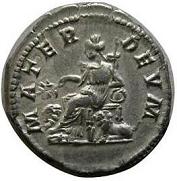
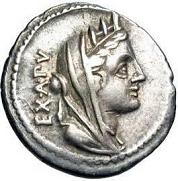
200 CE 67 BCE 102 BCE
An earlier Lidian coin which probably served as a model
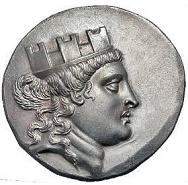
circa 150 BCE
Accounts of pre-Christian religion in Rome often say that the
Goddess Cybele was just one of many foreign imports, and of no
great significance. Although written records were relatively
easy to alter or destroy, coins were far too plentiful and
widely dispersed to receive such treatment. Without any doubt,
they continue to speak to us of a deity that was loved and
respected, and in which the common people placed their trust.
Clearly, the topic of pre-Christian religion has been very poorly portrayed by modern scholars. Even the secular contributions of the priests and priestesses has been consistently ignored. They were often the most literate members of their community, the teachers of the children, and the care-givers who tended the sick and comforted the dying... yet those sort of things are seldom mentioned in "scholarly" accounts of ancient religion.
I hope that my work can help to correct such misconceptions. In this document I have provided over 100 clickable reference links, which will take you to an appropriate Wiki page. Although they offer simplicity and convenience, Wiki pages sometimes also contain a certain amount of misinformation. Please rest assured that many far more authoritative sources were also consulted during my research for this project.
Here is a partial list of those sources...
Dr. Gordon Childe
Dr. Jacqueta Hawkes
Dr. James Mellaart
Dr. Marija Gimbutas
Dr. Mark Munn
Dr. Eberhard Zangger
Dr. Sanford Holst
Dr. Walter Burkert
The Museum of Anatolian
Civilizations
The British Institute
of Archeology
Oxford University
The University of Liege
The University of Chicago
Dartmouth College
Brown University
Finally, I'd like to take a moment to discuss the subject
of transgender people, because it is essential to a proper
understanding of pre-Christian religion, and also because
it remains so controversial in our modern world today.
As we know, recorded history began in Sumer around 3000 BCE. Some of the oldest surviving documents from that period refer to transgender persons serving as clergy in various temples. Moreover, linguists tell us that the official titles of such persons are not in any Proto-Indo-European dialect, but rather derive from the much older (indigenous) languages of the region. In other words, transgender people already occupied positions of authority in religious institutions long before the Kurgan invasion occurred.
As a result, the absorption of goddess religions into Kurganized societies carried with it an acceptance of transgender persons in various spiritual roles. What is really quite amazing is how consistently they have been found in similar roles, in other cultures around the planet. For example, in many Native American cultures transgender people commonly functioned as teachers and healers, as well as being thought to access a complex metaphysical dimension of the universe, foretell events, etc.
The positive social role which transgender people once played came to a tragic end when the Christians attained power. Their violent assault on other religions involved doing everything possible to discredit them... and since many of the goddess temples contained transgender clergy, they created the myth that transgender people were unnatural, and that they were promiscuous, prostitutes, pedophiles, etc. This served as a convenient pretext to drive them underground, or even murder them... and sadly, the same sort of hateful misinformation continues to cause similar problems for gender-variant people to this day.